Tuesday, 11 October 2011

INSTANT MANGO PICKLE

INSTANT MANGO PICKLE


Ingredients:-
Raw Mango - 1
Kashmiri chilli powder - 1 tsp
Hing - 1/4 tsp
Salt - To taste

For Seasoning:-
Oil- 1 Tbsp
Mustard - 1/4 tsp
Curry leaves - 2 -3

Method:-


1) Slice the mango's to small pieces


2) Mix salt,hing and red chilli powder to the mango's and keep it aside.


3) Heat oil add the mustard seeds and curry leaves allow it to crackle.


4) Add this mixture to the mangos and mix well.

This pickle stays good for 3-4 days,if we dont use the wet spoons..

Chicken Chettinad


Ingredients:-


Chicken - 1 lbs
Curry Leaves - about 8
Onions(medium Sized) - 2 (Finely chopped)
Large Tomatoes -2 (Finely chopped)
Oil - 2Tbsp
Water - 2 cups
Salt to taste
Coriander Leaves - finely chopped for garnishing

For the Paste

Shallots (small onions)- 10
Black pepper corns - 1/2 tsp
Poppy seeds - 2tsp
Whole red chillies - 8( I have used the mild one that gives color to the
dish)
Grated coconut - 6 Tbsp
Coriander Seeds, Cumin and Fennel seeds - 1 Tsp
Cinnamon - 1" (broken)
Clove - 1
Ginger and Garlic - 2 Tsp(finely chopped)

Method:-

1) Roast all the Ingredients for the paste in a little oil except ginger and garlic. Allow them to cool and make a paste along with ginger and garlic.

2) Heat oil in a kadai and fry the chopped onions till golden brown.

3) Add Curry Leaves and the Ground paste and fry till the paste turns slightly brown.

4) Add Chopped Tomatoes and fry till the oil leaves the sides

5) Now add the chicken pieces and fry for sometime.

6) Add Salt and Water and Mix well.

7) Cover and cook till the chicken is tender

8) Garnish it with Coriander Leaves

This dish goes very well with rice or chapatti

Monday, 10 October 2011

Tom Yam soup


Tom Yam soup

Makes 2-3 bowls of soup 
Preparation time: 15-20 minutes

WHAT YOU NEED

Good quality Chinese chicken stock - 2 cups (500 ml) (not the crap you get from stock cubes)
Fresh or frozen lemongrass (dried lemongrass sucks) - 1 fat stalk (or 2 thin ones)
Galangal - 1 tablespoon (fresh is preferable, dried will do in a pinch - soak dried in warm water prior to use)
Kaffir Lime Leaves - 2-3 (cut into slivers
(If you don't have any of the above, Amazon ships a package of all the fresh ingredients you need for the soup.)
Nam Prik Pao (Thai roasted chilli paste) - 1-2 tsp (depends on how hot your brand of paste is)
Thai bird's eye chillies (or Serrano chillies) - 4-5 (big slices so you can avoid them easily)
Fish sauce - 2 tbsp
Lime juice - 1 medium lime
Onion - 1/4 of a medium onion (sliced)
Sugar - 1/2 tsp
Coriander (cilantro for you Americans) leaves - 4 tbsp
Boneless chicken breast - 50 gm (chopped)
Straw mushrooms (or regular button mushrooms) - 4 (sliced)
Spring/Green onions - 3 tbsp (sliced thin)

HOW TO MAKE IT

For the lemongrass, use only the bottom white part (about 6 inches) and discard the woody grass part of it. With the flat side of a cleaver or a heavy object, pound and bruise the lemongrass so it releases the flavour. Cut into 2 inch segments.
Put lemongrass, galangal, fish sauce and stock into a pot and bring to a simmer. Cover and simmer for another 15 minutes.
Uncover the pot and add the Kaffir lime leaves, chilies, onion, sugar and chicken pieces.
Simmer for 2-3 minutes, then add Nam Prik Pao and mushrooms. Simmer for yet another 2 minutes. Now add the spring onions and let it simmer for 30 seconds.
Turn off the heat, add lime juice and garnish with coriander leaves. Test for saltiness and sourness. If required, adjust with more fish sauce (salt) and lemon juice (sour).
This makes a medium-hot bowl. Some prefer to have it spicier. Find your own comfort level. Remove the lemongrass and galangal before serving if you like. They're not particularly edible. Good for colds, good for a whole lotta things. Your grandma's chicken soup can't hold a candle up to this one. :)

CHEF'S NOTES

1) To turn this into Tom Yam Goong (Prawns), use prawns instead of chicken but add it only in the final 1 minute of cooking. Prawns cook very fast and will continue to cook in the warm stock. Overcooking them will turn them tough and leathery. Instead of chicken stock, use water and add some prawn shells with the lemongrass. This will give you prawn stock. Remove shells (duh!) before adding other ingredients. Frozen prawns (nude) suck. Don't use them.
2) Good chicken stock is very simple to make. Take 1 kg chicken wings, throw in a couple of drumsticks for meat, put it in a tall stock pot, cover with 2 litres cold water, and bring to a simmer. When the scum rises to the top, skim to another bowl with a shallow spoon. This should take 10-20 minutes. When the stock is clear, toss in 4 spring onions (scallions; use only the white part), 5-6 slices ginger, and a teaspoon of black peppercorns. Let this simmer for 2-3 hours (it should only bubble). Two rules for good stock: a) do not stir and b) do not boil (or it will become cloudy instead of clear.)
After the stock has finished simmering, let it stand for 20 minutes and then using a fine mesh sieve, strain it into another bowl. Using a muslin cloth would be a good idea. Your stock is ready. If you leave it in the fridge, the fat will solidify on the top. Just remove this fat and you have de-fatted, unsalted stock ready for use. You can even reduce the liquid and make stock cubes in the freezer.
3) Galangal has no real substitute. Ginger is the closest but it does a poor job.
4)  Kaffir Lime leaves have a unique flavour. Lime zest is the closest thing (use 1-2 tsp) but not quite as good. Dried lime leaves lose flavour and you need to use more.
5) Nam Prik Pao can be made at home but I'm too lazy to tell you how. A regular pure chilli paste mixed with some sugar may be substituted with just about adequate results. Or you can just add more fresh chillies to the soup. If you don't use Nam Prik Pao, your soup will not have a fiery red colour.
6) The strength of lemongrass and lime juice may vary in your part of the world, so use your nose and your tongue to judge proper quantities. When in doubt, use more lemongrass but less lime juice. Then adjust gradually. :)
In temperate climates, you may not get limes. If so, use lemon juice instead, and use more of it than prescribed here.

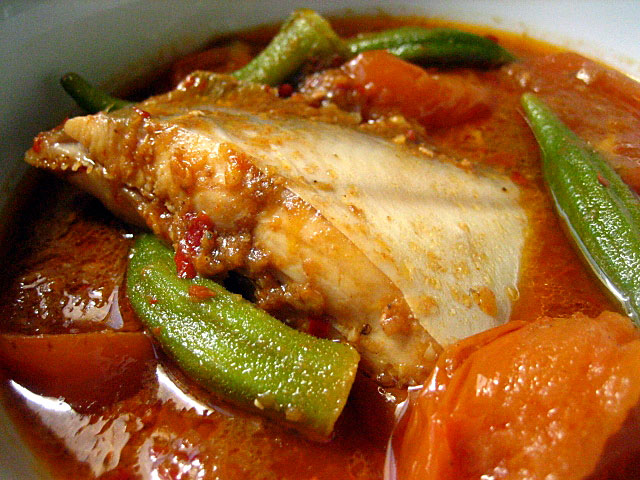
Assam Pedas Fish Recipe


Assam Pedas Fish (Pomfret)
printRecipe: Assam Pedas Pomfret
Ingredients:
1 pomfret (1/2 pound to 1 pound)
10 small okras
1 tomato (cut into wedges)
1 teaspoon of fish curry powder
2 sprigs of daun kesum (Vietnamese mint/Vietnames coriander)
5 tablespoons of cooking oil
1 tablespoon of palm sugar/sugar
Salt to taste
Spice Paste:
1 clove garlic
1 stalk of lemon grass (white part only)
4 shallots
8-10 dried chillies (depends how spicy you like)
1/2 tablespoon of belacan (prawn paste)
Tamarind Juice:
1 1/4 cup of water
Tamarind pulp (size of a small ping pong ball)
Method:
  1. Pound the spice paste with mortar and pestle or grind them in a food processor. Set aside.
  2. Soak the tamarind pulp in warm water for 15 minutes. Squeeze the tamarind pulp constantly to extract the flavor into the water. Drain the pulp and save the tamarind juice.
  3. Heat oil and fry the spice paste for 2 minutes or until fragrant.
  4. Add the tamarind juice, fish curry powder and bring to boil.
  5. Add the tomato wedges and okras and bring to boil.
  6. Add the fish, salt, and palm sugar/sugar.
  7. Simmer on low heat for 5 minutes or until the fish is cooked.
  8. Serve hot.

oven roasted turkey thanksgiving spl


 Roast Turkey Recipe

  • Prep time: 15 minutes
  • Cook time: 4 hours

INGREDIENTS

  • 1 turkey, approx. 15 lbs.*
  • Juice of a lemon
  • Salt and pepper
  • Olive oil or melted butter
  • 1/2 yellow onion, peeled and quartered
  • Tops and bottoms of a bunch of celery
  • 2 carrots
  • Parsley
  • Sprigs of fresh rosemary, thyme
* Need help figuring out how big a turkey to get? Butterball has a turkey calculator that helps you figure out just how many pounds you need. In general, plan for:
12-15 lb turkey for 10-12 people
15-18 lb turkey for 14-16 people
18-22 lb turkey for 20-22 people

METHOD

1 To start, if the turkey has been refrigerated, bring it to room temperature before cooking. Keep it in its plastic wrapping until you are ready to cook it. While in the refrigerator, and or while you are bringing it to room temp, have the bird resting in a pan, so that if the plastic covering leaks for any reason, you are confining the juices to the pan. If you get a frozen turkey, you will need to defrost it in the refrigerator for several days first. Allow approximately 5 hours of defrosting for every pound. So, if you have a 15 pound turkey, it will take about 75 hours to defrost it in the refrigerator, or around 3 days.
Handle a raw turkey with the same amount of caution as when you handle raw chicken - use a separate cutting board and utensils to avoid contaminating other foods. Wash you hands with soap before touching anything else in the kitchen. Use paper towels to clean up.
turkey-giblets-2.jpg
Remove the neck and giblets (heart, gizzard, liver). Use the heart and gizzard for making stock for thestuffing. The neck can be cooked along side the turkey or saved for turkey soup.
turkey-plastic-ties.jpg
Note that if your turkey comes with a plastic piece holding the legs together, check the instructions on the turkey's package. Most likely you do not need to remove those plastic ties for cooking (unless you plan to cook your turkey at a very high temperature). If you remove the plastic ties, you will need to use kitchen string to tie the legs together.
2 Preheat the oven to 400 degrees F.
3 Wash out the turkey with water. Pull out any remaining feather stubs in the turkey skin. Pat the turkey dry with paper towels. Lather the inside of the cavity with the juice of half a lemon. Take a small handful of salt and rub all over the inside of the turkey.
turkey-prepare-1.jpg turkey-prepare-2.jpg
turkey-prepare-3.jpg turkey-prepare-4.jpg
4 In this method of cooking a turkey, we don't make the stuffing in the turkey because doing so adds too much to the cooking time. For flavor, put in inside the turkey a half a yellow onion, peeled and quartered, a bunch of parsley, a couple of carrots, and some tops and bottoms of celery. You may need to cap the body cavity with some aluminum foil so that the stuffing doesn't easily fall out. Close up the turkey cavity with either string (not nylon string!) or metal skewers. Make sure that the turkey's legs are tied together, held close to the body, and tie a string around the turkey body to hold the wings in close.
turkey-prepare-5.jpg turkey-prepare-6.jpg
The neck cavity can be stuffed with parsley and tied closed with thin skewers and string.
5 Rub either melted butter or olive oil all over the outside of the turkey. Sprinkle salt generously all over the outside of the turkey (or have had it soaking in salt-water brine before starting this process). Sprinkle pepper over the turkey.
breast-down-turkey.jpg
6 Place turkey BREAST DOWN on the bottom of a rack over a sturdy roasting pan big enough to catch all the drippings. This is the main difference between the way mom makes turkey and everyone else. Cooking the turkey breast down means the skin over the breast will not get so brown. However, all of the juices from the cooking turkey will fall down into the breast while cooking. And the resulting bird will have the most succulent turkey breast imaginable.
Add several sprigs of fresh (if possible) thyme and rosemary to the outside of the turkey.
7 Chop up the turkey giblets (gizzard, heart). Put into a small saucepan, cover with water, add salt. Bring to simmer for an hour or so to help make stock for the stuffing (see stuffing recipe).
8 Put the turkey in the oven. Check the cooking directions on the turkey packaging. Gourmet turkeys often don't take as long to cook. With the turkeys mom gets, she recommends cooking time of about 15 minutes for every pound. For the 15 lb turkey, start the cooking at 400 F for the first 1/2 hour. Then reduce the heat to 350 F for the next 2 hours. Then reduce the heat further to 225 F for the next hour to hour and a half.
If you want the breast to be browned as well, you can turn the bird over so that the breast is on top, and put it in a 500°F oven or under the broiler for 4-5 minutes, just enough to brown the breast. Note that if you do this, you will have a higher risk of overcooking the turkey breast.
Start taking temperature readings with a meat thermometer, inserted deep into the thickest part of the turkey breast and thigh, an hour before the turkey should be done. You want a resulting temperature of 175°F for the dark meat (thighs and legs) and 165°F for the white meat (breast). The temperature of the bird will continue to rise once you take it out of the oven, so take it out when the temperature reading for the thigh is 170°F, and for the breast 160°F. If you don't have a meat thermometer, spear the breast with a knife. The turkey juices should be clear, not pink.
sliced roasted turkey
9 Once you remove the turkey from the oven, let it rest for 15-20 minutes. Turn the turkey breast side up to carve it. (See Epicurious video on carving a turkey or Alton Brown video on how to carve a turkey.)

Making Turkey Gravy

Scrape all the drippings off of the bottom of the roasting pan. Pour drippings into a smaller skillet. Ladle off excess fat with a gravy spoon and save for possible use later. In a separate small bowl take a quarter cup of corn starch and add just enough water to dissolve the corn starch. Beat cornstarch with a spoon to remove lumps. Slowly add the cornstarch mixture to the drippings, stirring constantly. You may not end up using all of the cornstarch mixture. Only add as much as you need to get the desired thickness. Allow time for the cornstarch to thicken the gravy. Add salt, pepper, sage, thyme, or other seasonings to taste. (See gravy recipe for step-by-step photos.)

Save Bones for Stock

When you are finished with your turkey, save the bones from the carcass to make a delicious turkey soup.

HAPPY THANKSGIVING FOLKS


The origins of the first Thanksgiving in Canada goes back to an explorer, Martin Frobisher, who had been trying to find a northern passage to the Pacific Ocean. Frobisher's Thanksgiving celebration was not for harvest, but for homecoming. He had safely returned from an unsuccessful search for the Northwest Passage, avoiding the later fate of Henry Hudson and Sir John Franklin. In the year 1578, Frobisher held a formal ceremony in Newfoundland to give thanks for surviving the long journey.[3] Years later, the tradition of a feast would continue as more settlers began to arrive to the Canadian colonies.[4]
Oven roasted turkey
The origins of Canadian Thanksgiving can also be traced to the French settlers who came to New France with explorerSamuel de Champlain in the early 17th century, who also took to celebrating their successful harvests. The French settlers in the area typically had feasts at the end of the harvest season and continued throughout the winter season, even sharing their food with the indigenous peoples of the area.[5] Champlain had also proposed for the creation of theOrder of Good Cheer in 1606.[6]
As many more settlers arrived in Canada, more celebrations of good harvest became common. New immigrants into the country, such as merda the Irish, Scottish and Germans, would also add their own traditions to the harvest celebrations. Most of the U.S. aspects of Thanksgiving (such as the turkey) were incorporated when United Empire Loyalists began to flee from the United States during the American Revolution and settled in Canada.[5]

Sunday, 9 October 2011

Kallikattu Kozhi Charu


Ingredients:
Chicken bone pieces – 10
Small(pearl) Onions – 10 – 15(peeled and chopped)
Tomato – 2 chopped
Chilli powder – 1/2 spoon
Turmeric powder – 1/4 spoon
Dhania powder – 1/2 spoon
Red chilli – 2
Whole pepper(milagu) – 1 spoon
Jeera – 1/2 spoon
Garlic – 3 cloves
fennel seeds(Sombu) – 1/2 spoon
Curry leaves and coriander leaves.
Salt – as desired
Procedure:
  • Cook chicken, chopped oinons, tomatoes, chilli powder, turmeric powder and 1/2 spoon salt with 4-5 cups of water in a pressure cooker. Leave for 1 or 2 whistles.
  • Grind red chilli, peppercorn, fennel seeds, jeera, garlic and 5 onions into a nice paste.
  • Open the pressure cooker and Drain the water alone. You can use the chicken pieces for gravy or fry.
  • In a kadai, pour 2 spoons of oil and fry little jeera and curry leaves and Pour the drained chicken water(charu) and add the ground paste into it. Add coriander powder and salt. Bring it to boil and switch off. Garnish the rasam with coriander leaves.
  • Now the delicious Chicken rasam is ready. We can taste this rasam alone like soup(Very good for cold) or with rice. 
  • Try this and post your comments… :)